When it comes to factory automation, lining parts into the right position is one of the most critical challenges. When you are feeding thousands of tiny screws, bottle caps, or automotive parts, components can arrive in very disorganised piles.
To help streamline the process, vibratory bowl feeders help to turn that chaotic jumble into a perfectly aligned, single-file line ready for assembly.
As production lines have become smarter and faster, feeding technology has branched out. Let’s explore the three core types of vibratory bowl feeders, including conventional, EcoType™, and digital, to see how modern manufacturing keeps things moving.
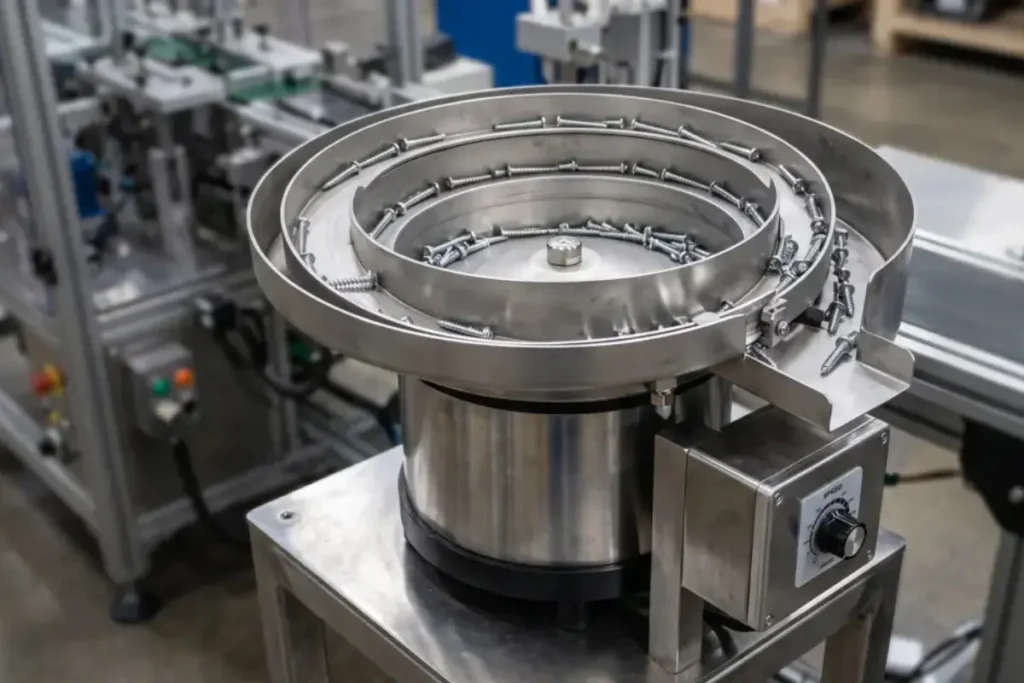
Conventional Bowl Feeders
Conventional vibratory bowl feeders are the traditional foundation of automated part handling. They are highly flexible systems designed to orient complex shapes and unique geometries that standard off-the-shelf equipment cannot manage.
How They Work
A standard setup consists of three main elements: a drive unit, a custom-tooled bowl, and a variable-amplitude control box. The drive unit creates a controlled, high-frequency vibration that coaxes the parts to climb an inclined, circular track. As the parts march upwards, they encounter custom-engineered mechanical obstacles or “tooling”. If a part is upside down or backward, the obstacle safely drops it back into the bottom of the bowl to try again. Only perfectly orientated parts make it to the final discharge track.
Key Characteristics & Benefits
- Incredible Versatility: Conventional systems can be engineered to handle a massive range of sizes, with bowls ranging from a tiny 69 mm to a massive 1,200 mm in diameter.
- Specialised Linings: To protect fragile parts, reduce noise, and increase traction, the interior tracks can be coated in materials like polyurethane, Habasit, brush, flock, or Metaline.
- Advanced Drive Technology: Leading manufacturers like RNA Automation use patented multi-magnet drive units. These systems minimise the amount of vibration transferred to the surrounding assembly machinery, ensuring smooth, quiet, and consistent feeding.
EcoType™ Bowl Feeders
Not every manufacturing line requires a completely bespoke, highly complex feeding system. If your facility primarily deals with simple, standard industrial hardware, a conventional custom bowl can often be over-engineered and unnecessarily expensive. This is where EcoType™ bowl feeders step in.
The Standardised Approach
The EcoType™ series is designed specifically for simple, free-flowing component parts that do not require complex, multi-stage separation or individual part gating. Think of high-volume fasteners like the following:
- Screws, nuts, bolts, and rivets
- Pins, nails, and washers
- Simple rubber O-rings
Because these geometries are mathematically predictable and straightforward, minimal design effort is required to sort them. Manufacturers can draw from vast historical databases of proven, simple feeding templates rather than designing a track entirely from scratch.
Key Characteristics & Benefits
- Economical Production: By standardising the drive units (typically sizes 200, 250, and 400) and using standardised aluminium cylindrical or stepped bowls, EcoType feeders offer a far lower price point and significantly shorter lead times.
- High Throughput: Despite being a budget-friendly option, these single-track systems are incredibly efficient, capable of delivering up to 200 parts per minute to downstream machinery.
- Built to Last: These bowls come standard with an internal polyurethane spray coating. This tough lining dampens the harsh noise of metal-on-metal contact and protects the screws or pins from cosmetic wear and tear during operation.
Digital Bowl Feeders
On the opposite end of the spectrum lies the cutting edge of industrial automation: digital bowl feeders. Historically, designing a bowl feeder for an intricate, lightweight, or highly irregular part was as much an art form as a science. Toolmakers relied on physical trial-and-error, manually cutting and welding mechanical gates during commissioning until the parts behaved.
Digital bowl feeders replace this physical guesswork with advanced software physics, AI, and 3D geometric deep learning.
How They Work
Before a single piece of metal is cut or a printer is powered on, engineers build a comprehensive “digital twin” of the entire feeding system. Using multi-physics simulation, the client’s CAD models are run through a virtual environment. The software tests the component’s preferred seating positions, models how the bulk material will accumulate, simulates the separation process, and virtually balances the drive springs and vibration frequencies.
Once the digital simulation achieves perfect, predictable performance, the sorting tracks are manufactured directly using precision CNC-milling or additive 3D printing (often using a durable nylon material with anti-static additives).
Key Characteristics & Benefits
- 100% Reproducibility: Because the entire track geometry exists as a digital CAD/CAM file, a digital bowl feeder can be perfectly replicated. If a global manufacturer needs identical feeding lines in factories across three different continents, the systems will perform identically without needing on-site, manual tool adjustments.
- Perfect for Intricate Parts: Digital feeders excel at handling fragile or ultra-precise “filigree” parts common in the electronics and medical device industries, such as miniature pushers, delicate seals, or complex plastic inserts.
- Reduced Project Risk: Because feasibility and feed rates are digitally validated prior to production, the risk of unexpected deployment delays or costly mechanical rework during final factory acceptance testing is virtually eliminated.
By pairing the right mechanical or digital feeding technology to your specific component type, you can dramatically reduce noise, minimise part wear, cut labour costs, and keep your automated assembly lines running seamlessly.
