A crypto claw bucket is a hybrid excavator attachment that combines the digging power of a standard bucket with the gripping force of a dual-cylinder clamp. Unlike bucket-and-thumb combinations that require separate tools and welding, claw buckets attach just like a standard bucket—no modifications needed. They excel at demolition, land clearing, and material handling because they let operators dig, grip, crush, and load all with 100% of the excavator’s reach maintained through every motion.
What Is a Crypto Claw Bucket? (And Why It Matters)
A crypto claw bucket is a patented excavator attachment that handles two jobs at once: the bucket’s digging capability and a grapple’s gripping power. The design features wide, heavy-duty dual-cylinder clamps that open and close with a single operator valve, plus an open multi-rib format so you can see what you’re doing at all times.
The tool was pioneered by Rockland Manufacturing under the brand name Krypto Klaw®, which dominates the U.S. market. Competing brands like Crypto Claw also offer hydraulic thumb variants, but the Krypto Klaw design remains the category leader for true dig-and-grip versatility.
The key innovation: you don’t lose reach when you grip. Traditional bucket-and-thumb combos force operators to reposition the arm or retract the thumb to maintain control. With a claw bucket, the clamp integrates into the bucket itself, so operators maintain 100% of the excavator’s reach through the entire curl cycle.
Crypto Claw vs. Bucket & Thumb vs. Grapple Head-to-Head Comparison
Here’s where the real value emerges. Let’s stack all three against each other across the dimensions that matter on site.
| Feature | Crypto Claw Bucket | Bucket & Thumb | Excavator Grapple |
| Digging Capability | Excellent | Very Good | Limited (can’t dig) |
| Gripping / Loading | Excellent | Good | Excellent |
| Excavator Reach | 100% maintained | Reduced (thumb blocks reach) | Limited (grapple arm is short) |
| Installation Time | 15–30 min (quick-connect) | 2–4 hours (welding + brackets) | 2–4 hours (welding + struts) |
| Versatility | Very High (dig + grab + crush) | Good (dig OR grab, not both efficiently) | Limited (grab only) |
| Operator Visibility | Open design = excellent | Good | Limited (arm obscures view) |
| Attachment Swaps Needed per Job | Minimal (1 tool does it all) | Frequent (swap thumb on/off) | Frequent (swap grapple bucket for digging) |
| Typical Cost | $$$ (35K–55K new) | $$ (18K–35K) | $$$ (40K–65K) |
| Maintenance | Moderate | Low | Moderate |
The bottom line: If your job involves both digging and gripping—demolition, land clearing, recycling—the crypto claw bucket eliminates the attachment-swap bottleneck. You do more work without downtime. If you’re doing pure digging or pure gripping, a simpler, cheaper tool might suffice.
Key Benefits & Why Operators Prefer Claw Buckets
Once operators experience a claw bucket on the right job, they rarely go back. Here’s why:
- Unmatched versatility. Dig, rip, grab, crush, squeeze, and load without changing tools. One attachment replaces two or three.
- 100% excavator reach through the entire cycle. The clamp doesn’t retract like a thumb does. Operators can grip material at full extension—critical for demolition and salvage.
- Fast installation. Attaches like a standard bucket. No welding, no strut brackets, no 4-hour installation nightmare. Just pin-on and plug in hydraulics.
- Superior operator control. Single-valve controls with dual-cylinder clamping force. Less guesswork, faster learning curve for new operators.
- Exceptional visibility. The open multi-rib clamp design means you see exactly what you’re grabbing. Safer, fewer dropped loads.
- Works on coupler or pin-mount machines. No custom brackets. Moves between fleet machines in minutes.
- Handles oversized material. Material bigger than a bucket can hold, grippable material a bucket can’t manage—a claw handles both.
Crypto Claw Bucket Specifications & Variants
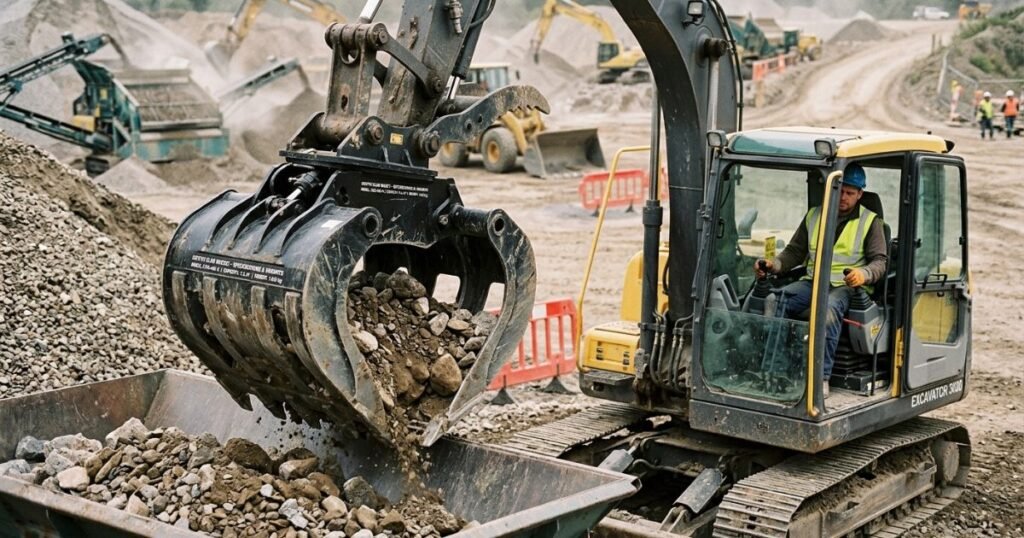
Specifications vary by brand and model, but here’s what you’ll find on the market-leading Rockland Krypto Klaw line:
Standard Krypto Klaw Model:
- Throat Opening: 81 inches
- Bucket Width: 48 inches
- Weight: 4,900 lbs
- Recommended Carrier: 27–30 metric ton excavator
- Hydraulic Flow: 15–25 GPM (gallons per minute)
Krypto Klaw Skeleton Variant:
- Similar opening / width, but lighter weight (reduced floor plate, open design)
- Best for: Recycling and sorting operations where you’re sifting rather than heavy digging
- Weight: 3,800–4,200 lbs (depending on configuration)
HD (Heavy-Duty) Variant:
- Reinforced clamp cylinders and wear areas
- Best for: Demolition and heavy ripping operations
- Weight: 5,200–5,600 lbs
All variants attach the same way and work with the same hydraulic quick-connect system.
How to Install a Crypto Claw Bucket on Your Excavator
Installation is a major selling point. Here’s the real-world step-by-step:
1. Park on stable, level ground and engage the bucket fully. Lower the bucket all the way down, engage the blade against the ground.
2. Disconnect the existing bucket. Remove the two pins holding your current bucket in place. Slide the bucket out of the coupler or frame.
3. Align the claw bucket. Guide the new claw bucket into the pin-mount holes or coupler on your excavator’s arm.
4. Secure the pins. Insert and lock the two attachment pins. Tighten retaining clips to manufacturer spec (typically a wrench-tight fit, not over-torqued).
5. Connect hydraulic quick-couplers. Plug the two hydraulic hoses from the claw bucket into the excavator’s auxiliary hydraulic outlets. These are color-coded and spring-loaded for quick connection—they practically plug themselves in.
6. Test at half-throttle. Lower the bucket slightly, engage the clamp valve at 50% power. Listen for smooth operation and check all hose connections for leaks.
7. Full operation. Once you’re confident, move to 100% power and full clamp cycling.
Total time: 15–30 minutes. Compare that to bucket-and-thumb installation (2–4 hours including welding and testing). This speed is why rental companies love claw buckets—fast turnover, minimal downtime for clients.
Best Uses by Application
Crypto claw buckets don’t fit every job, but they dominate specific applications:
Demolition Grab concrete chunks, rebar bundles, and steel beams. The dual-cylinder clamp provides crushing force—perfect for breaking up concrete and holding twisted rebar secure. Operators report better control and less spillage than bucket-and-thumb combos on demolition work.
Land Clearing Dig tree roots, rip stumps, grab cleared debris, and load trucks—all without swapping attachments. On a 27-ton excavator, you can handle the full workflow: dig → grab root ball → shake dirt → load. This is where claw buckets shine for productivity.
Recycling & Sorting The Skeleton variant (lighter weight, open floor) excels at sifting mixed materials. Sort scrap metal, wood, and commingled construction waste without the weight penalty of a standard bucket.
Material Handling Load trucks faster than bucket-and-thumb setups because you don’t waste cycles repositioning the arm to grip with a thumb. Contractors report 20–30% faster loading times on repetitive truck-loading jobs.
Site Prep & Utility Work Rip compacted soil, grab rocks and root balls, dig utility trenches—all tasks where you need both digging and gripping in quick succession.
Krypto Klaw vs. Other Leading Brands
Rockland Krypto Klaw (Market Leader)
- Pros: Patented design, widest dealer network, multiple variants (Standard, HD, Skeleton), strong field reputation, excellent parts support
- Availability: Nationwide through equipment dealers, rental companies, and online platforms
- Price Range: 35,000–55,000 new; 15,000–40,000 used
Crypto Claw (Hydraulic Thumb Brand)
- Pros: Lighter-duty option, cost-competitive on some models, available through regional dealers
- Cons: Less universal brand recognition, smaller dealer network, fewer variant options
- Price Range: 25,000–45,000 (varies by model)
JM Attachments Claw Buckets
- Pros: Budget-friendly alternative, decent build quality, available through online marketplaces
- Cons: Fewer customization options, less field data on longevity
- Price Range: 20,000–40,000
Bottom Line: If you’re buying or renting, Rockland Krypto Klaw commands the best resale value and dealer support. If you’re renting, check regional availability—many rental companies stock Rockland exclusively. If you’re buying used, inspect hydraulic cylinders closely regardless of brand.
Cost, Rental & Purchasing Options
New Claw Bucket (Purchased)
- Typical range: 35,000–55,000
- Installation: Usually included by dealer
- Warranty: Typically 12 months against manufacturing defects
- Payback timeline: Breaks even in 12–18 months of heavy use (10+ days per month)
Used / Refurbished Claw Bucket
- Typical range: 15,000–40,000 (depends on hours, condition, brand)
- Inspection critical: Check hydraulic cylinder seals, clamping action, wear on clamp teeth
- Warranty: Usually “as-is” or 90 days (negotiate)
- Value proposition: Fast payback if you find a well-maintained unit
Rental (Short-Term)
- Typical cost: 800–1,500 per month (varies by region and machine size)
- Fuel & transport: Usually included; delivery/pickup may add 200–500
- Best for: Projects under 3 months; operators testing before buying
- Availability: Check local equipment rental companies, or national platforms like EquipmentShare
Buy vs. Rent Decision Matrix:
- Rent if: Project < 3 months, unsure of long-term use, want to test before buying
- Buy if: Regular heavy use (>200 days/year), own an excavator, plan 5+ years of use
- Finance: Many dealers offer equipment loans; some manufacturers offer lease-to-own
Maintenance, Durability & Safety Tips
Hydraulic System Maintenance
- Inspect hoses and cylinders monthly
- Flush hydraulic fluid annually (or per manufacturer spec)
- Replace hydraulic filters every 500 operating hours or annually
- Check quick-couplers for leaks after each use
Clamp Teeth & Wear Areas
- Clamp teeth wear down over time (normal)
- Replace teeth when worn by 50% (bolt-on design, DIY-friendly)
- Reinforced wear areas on the bucket floor and clamp arms last 5,000–10,000 operating hours
Operator Safety Best Practices
- Never exceed the clamp’s rated load capacity (check manufacturer specs for your carrier size)
- Keep bystanders clear of the clamp zone—no pinch-point entry
- Load balance: center heavy loads in the clamp, don’t tip
- Fatigue management: The open design and smooth controls reduce operator strain vs. traditional thumbs
- Personal protective equipment: Hard hat, safety glasses, high-visibility vest
Typical Lifespan A well-maintained claw bucket lasts 5,000–10,000 operating hours, similar to comparable grapple buckets. Regular maintenance extends life; neglect shortens it.
Conclusion
The crypto claw bucket is a game-changer for contractors and equipment operators juggling multiple attachment needs on a single job. By combining bucket and grapple capabilities—and eliminating the installation nightmare of bucket-and-thumb combos—it cuts downtime, boosts productivity, and simplifies fleet management.
FAQs
How much faster is a claw bucket compared to a bucket and thumb on a typical loading job?
Contractors typically report 20–30% faster cycle times on repetitive loading and material handling work. On demolition jobs with mixed digging and gripping, time savings can reach 40% because you eliminate attachment swaps. The exact gain depends on the job mix—pure digging jobs see less improvement than mixed work.
Will a claw bucket work with my excavator model?
Claw buckets fit 27–30 metric ton excavators (roughly 60,000–66,000 lbs operating weight) as standard. Smaller machines (13–20 MT) have lighter-duty options; larger machines (35+ MT) require custom or semi-custom models. Check your excavator’s operating manual for hydraulic flow capacity (typical requirement: 15–25 GPM) and coupler type (pin-on or quick-coupler). Contact the bucket manufacturer with your machine’s model number for compatibility confirmation.
Is a claw bucket safe for inexperienced operators?
Yes, with proper training. The single-valve control system is actually simpler and safer than traditional thumb operation. New operators typically master the controls in one shift. Recommend 2–4 hours of supervised operation before full-speed use, and always brief operators on load limits and bystander safety.
What’s the maximum load a claw bucket can grip?
Load capacity depends on carrier size and bucket model. A standard Krypto Klaw on a 28-ton excavator typically grips 8,000–12,000 lbs at full reach, less as the arm retracts (geometry changes). Check your bucket’s spec sheet for load tables, and never exceed the rated capacity—overloading stresses cylinders and can cause hydraulic failure.
How do I find a rental company near me that has claw buckets?
Search “claw bucket rental near me” or contact major national rental chains: United Rentals, Herc, Neff, and regional operators often stock them. Rockland’s website has a dealer/rental locator. Expect 1–2 week lead time for popular locations; book early for peak seasons.
What’s the difference between the Standard, Skeleton, and HD models?
- Standard: All-purpose; good balance of digging and gripping for demolition and land clearing
- Skeleton: Lighter weight (open floor design); optimized for sorting and sifting operations; less ideal for heavy ripping
- HD (Heavy-Duty): Reinforced cylinders and wear areas; built for non-stop demolition and ripping; slightly heavier
Choose based on your primary task: digging & gripping = Standard; sorting & sifting = Skeleton; demolition & ripping = HD.
