V5 INC RET PS is a TD Bank code that means a cheque you deposited has been returned and the funds have been reversed from your account. This typically happens because the sender didn’t have sufficient funds, made errors on the cheque, or their bank cancelled it. A return fee—usually $15 to $35—will also be deducted from your account.
What V5 INC RET PS Really Means: The Basics
If you’ve just spotted this code on your bank statement, you’re probably confused. Bank codes feel like a language designed to frustrate, but this one is straightforward once you break it down.
V5 INC RET PS stands for a bounced cheque—a cheque payment that failed to clear. Here’s what happened: you deposited a cheque into your TD Bank account, expecting the money to land. The check made it to the sender’s bank for processing, but their bank rejected it. Your bank (TD) then reversed the deposit, showed it on your statement as V5 INC RET PS, and likely charged you a return fee.
The key thing to understand: you’re not at fault. Someone else’s check didn’t work. But it’s your problem to fix—because the money’s gone from your account and your bank is asking for a fee.
Breaking Down Each Part of the Code
Understanding what V5, INC, RET, and PS mean will help you explain this to your bank or the cheque sender with confidence.
| Component | Stands For | What It Means |
| V5 | Bank Transaction Code | TD Bank’s specific identifier for this type of return |
| INC | Incoming | The funds were supposed to come into your account |
| RET | Returned | The cheque was rejected and the transaction was reversed |
| PS | Payment Stopped | The reason—either insufficient funds or another stop reason |
So when you read “V5 INC RET PS,” it translates to: “Incoming cheque returned because payment was stopped.”
V5 INC RET PS vs. Related Codes: What’s the Difference?
You might see other codes on your statement that look similar. Here’s how they compare:
| Code | Meaning | Who Pays the Fee |
| V5 INC RET PS | Cheque you deposited bounced | You (receiver) |
| NSF Fee | Insufficient funds on your account | You (account holder) |
| Return Item | Generic cheque/item return (not TD-specific) | Varies by reason |
The key difference: V5 INC RET PS is about someone else’s problem. NSF is about your problem.
Why Cheques Bounce: The 5 Most Common Reasons
A check doesn’t bounce for mysterious reasons. There’s always a cause. Understanding why helps you either prevent future bounces (if you’re the sender) or know how to handle the current situation (if you received one).
1. Insufficient Funds: The Most Common Reason
This is the #1 reason cheques bounce. The person who wrote the check simply didn’t have enough money in their account to cover it.
Real scenario: Sarah writes you a check for $500 for a used laptop. At the time she writes it, she believes she has the funds. But two days later, a large bill came out of her account. By the time the cheque reaches your bank, her account balance is $300. Your bank tries to collect the $500, can’t, and returns the cheque to you as V5 INC RET PS.
What happens next: The cheque is rejected, her bank charges her a fee (usually 25–35), and your bank charges you a fee for the returned item. Nobody’s happy.
2. Incorrect Information on the Cheque
Even tiny errors make cheques invalid. Banks are strict about this because cheques are legal documents.
Common mistakes:
- Misspelled name The recipient’s name doesn’t match account records
- Wrong date Cheque is post-dated (written for a future date) or has an invalid date
- Amount mismatch The numbers ($500) don’t match the written words (five hundred dollars)
- Missing or mismatched signature No signature or a signature that doesn’t match the account holder’s
Real scenario: Your landlord writes you a check but spells your name “Micheal” instead of “Michael.” When you deposit it, the bank flags the name discrepancy. The check gets returned. It’s fixable—they can write a new check—but it’s frustrating.
3. The Bank Cancelled the Cheque
Sometimes the sender’s bank stops payment on a cheque before it clears.
Why would this happen?
- The sender requested a stop-payment (usually because they lost the cheque or changed their mind about the payment)
- The account was frozen or restricted
- The account was closed
Real scenario: Your contractor writes you a cheque for $2,000. Three days later, they realize they sent two cheques instead of one and ask their bank to stop payment on the first one. Your bank tries to process it, gets a “stop payment” notice from their bank, and returns it as V5 INC RET PS.
4. Overwriting or Alterations
If a cheque has been changed or rewritten, banks will refuse it. This is a fraud-prevention measure.
Real scenario: Someone writes a check for $100 but tries to erase it and change it to $1,000. Even if the erasure looks clean, banks have tools to detect alterations. The check gets rejected. This is also why financial institutions tell you: never alter a cheque. If you make a mistake, avoid it and write a new one.
5. Account Closed or Frozen (Less Common, But It Happens)
If the account the cheque is drawn from has been closed or frozen, the cheque can’t clear.
What Happens When a Cheque Bounces The Timeline
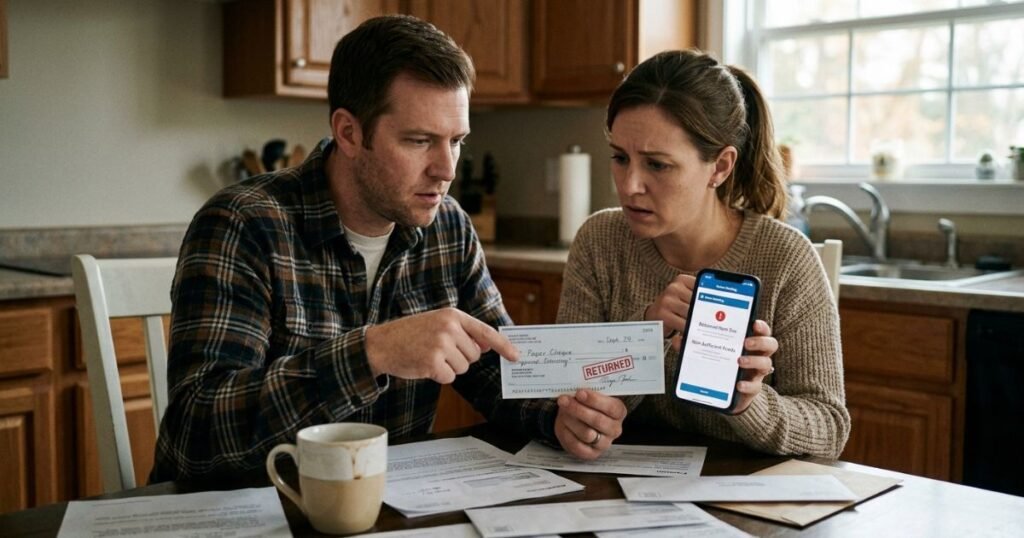
Knowing the timeline helps you understand what’s happening and when you can expect it to be resolved.
Day 1: Cheque Deposited You deposit the cheque into your TD Bank account (in-branch, ATM, or mobile deposit). TD Bank credits the funds to your account provisionally. They haven’t actually collected the money yet.
Day 2–3: Bank Processing TD Bank sends the cheque to the sender’s bank for collection. The sender’s bank receives it and begins processing. If the sender’s bank sees any issues—insufficient funds, wrong information, stop payment request—they flag it.
Day 3–5: Bank Rejects the Cheque The sender’s bank officially rejects the cheque and sends it back to TD Bank with a reason code (V5 INC RET PS means “returned due to insufficient funds or payment stopped”).
Day 4–7: TD Bank Reverses the Deposit TD Bank receives the rejection, removes the funds from your account, and adds the V5 INC RET PS line item to your statement. You see a negative entry showing the cheque amount has been deducted. You also see a return fee (typically 15–35) charged separately.
Day 5–10: You Get Notified TD Bank notifies you via email, text, or statement of the returned cheque. Some banks also notify the sender’s bank, which notifies them.
After Day 10: Resolution Needed It’s now on you to contact the sender and resolve the issue. Most bounces clear within 5–7 business days total, but if you delay contacting the sender, resolution takes longer.
How to Handle a V5 INC RET PS Code Your 4-Step Action Plan
Don’t panic. Bounced cheques are fixable. Follow these steps in order.
Step 1: Confirm the Bounce With Your Bank
What to do:
- Contact TD Bank customer support via phone, online chat, or your banking app
- Have your account number and statement date ready
- Ask: “Why was cheque #[number] for $[amount] returned?”
- Specifically ask: “What is the exact reason for the return?”
What to expect: The bank will tell you one of the five reasons above. They’ll also confirm the return fee charged (usually 15–35, but varies).
Pro tip: Ask if the fee can be waived. If it’s your first bounce and you’re otherwise a good customer, TD Bank might reverse it as a courtesy.
Step 2: Contact the Cheque Sender Immediately
What to do:
- Call or email the person who wrote the cheque
- Stay calm and professional (they might not know it bounced yet)
- Tell them: “Your cheque for $[amount] was returned by the bank. Can you tell me why?”
- Ask: “Can you reissue it or use a different payment method?”
What not to do:
- Don’t accuse them of fraud or being irresponsible
- Don’t post about it publicly or vent to others
- Don’t assume they did it on purpose
Real conversation example:
You: “Hi Sarah, the cheque you sent me for $500 came back from the bank. It shows insufficient funds in your account. Can you issue a replacement?” Sarah: “Oh no! I thought that cleared. Let me send you a bank transfer instead—will that work?”
This is the ideal outcome.
Step 3: Get a Replacement Payment
Best options, in order:
- Bank transfer / e-transfer Fastest and most reliable. Usually it is the same-day or next business day.
- New cheque If they insist on a cheque, ask them to verify their account balance first.
- Credit card payment If applicable (especially for businesses).
- Digital wallet payment (Venmo, PayPal, etc.) Quick and trackable.
Important: Wait 2–3 business days after receiving the replacement payment to confirm it clears. Don’t assume it’s safe until you see it in your account.
Step 4: Request a Fee Reversal from Your Bank
What to do:
- After you’ve confirmed the new payment cleared, call TD Bank again
- Politely ask: “Can you waive the $25 return fee given that the cheque issue has been resolved?”
- Mention: “This is my first bounced cheque” (if true) or “I’ve been a customer for [X] years”
Realistic expectation: Banks will waive one-off fees about 50% of the time, especially for first-time bounces. It’s worth asking.
Legal Consequences & Financial Impact: What Actually Happens?
A bounced cheque isn’t just an inconvenience—it has real financial and legal implications. Here’s what you need to know.
Bank Fees (the Immediate Cost)
Your costs:
- Bounced cheque return fee: 15–35 (charged to your account)
- Overdraft fee: If the bounce triggers an overdraft, you’ll pay an additional fee
Sender’s costs:
- Their bank also charges them a return fee
- In total, the bounce costs both of you money
Total financial impact: 30–70 between the two of you, plus the inconvenience.
Impact on Your Credit Score
Good news: A single bounced cheque does not directly affect your credit score. Banks don’t report bounced cheques to credit agencies.
Bad news: If the bounced cheque escalates—for example, if the recipient sues you or the amount goes to collections—then it can affect your credit.
Civil Action: Can I Be Sued?
Yes, but only under specific circumstances.
If you’re the recipient of a bounced cheque and it was for a significant amount, you have the right to:
- Sue the sender for the cheque amount
- Recover the bank’s return fee
- Recover any damages or late fees you incurred as a result
Example: You agreed to sell your car for $8,000, received a cheque that bounced, and couldn’t pay your own bills on time because of it. You could potentially sue the sender for $8,000 + your $25 return fee + late fees you incurred.
The catch: You’d have to go to small claims court or hire a lawyer. For small amounts (100–500), it’s often not worth it.
Criminal Risk (Depends on Intent & Jurisdiction)
In some jurisdictions, knowingly writing a check with insufficient funds can be criminal fraud.
What this means:
- If someone writes a cheque knowing they don’t have the funds, and does it intentionally to deceive you, it’s fraud
- Criminal penalties can include fines and even jail time
- This varies dramatically by state/province and whether the sender’s actions were negligent or intentional
Real-world context: A one-off bounced cheque due to bad budgeting is unlikely to result in criminal charges. A pattern of bouncing cheques intentionally? That’s different.
Business & Reputation Risk
If you’re a small business owner and you issue a bounced cheque, your reputation takes a hit. Vendors and clients may refuse to accept cheques from you in the future. This is why established businesses rarely use cheques anymore.
Whose Fault Is It? Determining Responsibility
The responsibility for a bounced cheque depends entirely on why it bounced.
Decision Table: Who’s at Fault?
| Reason for Bounce | Who’s Responsible | What Happens Next |
| Insufficient funds | Sender | Sender must reimburse and cover their own bank fee |
| Wrong name/date/amount | Depends—who filled out the cheque? | The person who made the error should issue a corrected cheque |
| Cheque was altered | The person who altered it | They’re liable for fraud |
| Bank cancelled it | Sender (usually requested cancellation) | Sender should have informed you; they need to reissue |
| Account closed/frozen | Sender | Sender must provide alternative payment method |
Key principle: The person who caused the problem should be the one to fix it. But in practice, you’ll likely just ask for a replacement and move on.
How to Avoid V5 INC RET PS in the Future
Prevention is always better than dealing with a bounced check. Here’s how both senders and receivers can avoid this headache.
If You Receive Cheques (What to Do)
- Verify funds before accepting — For large cheques ($1,000+), ask the sender if they have the funds available. It’s not rude; it’s practical.
- Deposit cheques quickly — The sooner you deposit, the sooner the sender’s funds need to be available. If you wait two weeks, their situation could change.
- Request digital payment instead — Offer the sender options: “Can you do an e-transfer or bank transfer? It’s faster and more secure than a check.”
- Set up account alerts — Many banks let you set up alerts for returned items. Enable this so you know immediately.
- Keep records — Keep a copy of the cheque and note the return. If you need to pursue the matter legally, you’ll have documentation.
If You Write Cheques (What to Do)
- Always verify your balance — Before writing a cheque, confirm your account has the funds.
- Double-check all details — Recipient name, amount (numbers and words), date, and signature. Get it right the first time.
- Never overwrite a cheque — If you make a mistake, avoid it and start over. Overwritten cheques are almost always rejected.
- Inform the recipient when issuing — If you’re giving a cheque for an important payment, tell them when to expect it and confirm receipt.
- Consider going digital — Cheques are outdated. Use bank transfers, e-transfers, or digital payments. They’re faster, safer, and have confirmation receipts.
Other Confusing TD Bank Codes You Might Encounter
Understanding bank codes is important for managing your finances. Beyond V5 INC RET PS, here are other codes that commonly appear on statements.
DDA Debit (Demand Deposit Account Debit)
A withdrawal or transfer from your checking or savings account. This is normal and expected.
NSF Fee (Non-Sufficient Funds Fee)
Charged when you try to make a payment but don’t have enough money. Different from a bounced cheque—it’s your account that’s short, not someone else’s.
ACH Debit (Automated Clearing House Debit)
An electronic transfer you authorized for bill payments, subscriptions, or recurring charges. Usually automatic; always review these on your statement.
POS (Point of Sale)
Debit or credit card purchase at a store or online. Standard transaction.
ATM Withdrawal
Cash withdrawn from an ATM. Shows up with the ATM location.
Return Item
Generic code for any cheque or item that was returned for any reason (not just bounces). V5 INC RET PS is a specific type of return item.
Conclusion
V5 INC RET PS means a cheque you deposited didn’t clear. The sender didn’t have sufficient funds, made an error on the check, or their bank cancelled it. Your funds have been reversed and you’ve likely been charged a return fee. Contact your bank to understand the reason, reach out to the sender for a replacement payment, and ask if your return fee can be waived. Resolve it within 5–10 days, and move forward. Most importantly, consider switching to digital payments—cheques are slow, unreliable, and create exactly this kind of friction.
FAQs
Is V5 INC RET PS specific to TD Bank only?
Yes. TD Bank uses this specific code. Other banks use different codes for bounced cheques. If you bank with another institution and see a bounced cheque code, it will look different (though it means the same thing). Always check your bank’s statement guide if you’re unsure what a code means.
How long does it typically take to resolve a bounced cheque?
The bounce itself resolves within 3–7 business days (from deposit to reversal). However, resolving the situation—getting a replacement cheque or payment—depends on how quickly you contact the sender and how quickly they can reissue. Most people resolve it within 5–10 days if they act quickly.
What’s the difference between V5 INC RET PS and NSF?
V5 INC RET PS is a code on someone else’s cheque that bounced. NSF is a fee you get charged when your account doesn’t have enough money to cover a transaction. Different problems, different fees.
Can I get the return fee waived?
Possibly. Call TD Bank and explain the situation, especially if it’s your first bounce. Banks often waive one-off fees as a courtesy. The success rate is roughly 50/50, but it’s always worth asking.
Will a bounced check hurt my credit score?
Not directly. A single bounced cheque doesn’t report to credit agencies. However, if the situation escalates to a lawsuit or collection action, then it could affect your credit. Don’t panic—handle it promptly and it won’t touch your credit.
What if the cheque sender won’t respond or won’t reissue?
Document everything—keep the bounced cheque, emails, texts, and notes of your contact attempts. If it’s a small amount (100–500), you might have to write it off. If it’s larger, you can pursue small claims court or hire a lawyer. This is rare for personal cheques but more common for business payments.
Can I dispute a bounced cheque?
Only in specific cases: if the return reason is incorrect (e.g., you’re told it was NSF but you know the sender had funds), if there’s evidence of fraud, or if the bank made an error. Standard bounces (insufficient funds, incorrect cheque info) cannot be disputed—they’re legitimate returns.
What should I do if I’m the one who wrote the bounced cheque?
Contact the recipient immediately. Apologize, explain briefly, and offer a replacement. Offer to cover their return fee (or at least split it). If it was a debt or payment obligation, consider using a more reliable payment method going forward. Taking responsibility quickly will minimize damage to your reputation.
Are there legal consequences for bouncing a check?
It depends. A single bounce due to bad accounting is unlikely to result in legal action. However, if the recipient sues you, you’re liable for their damages, fees, and the cheque amount. In rare cases with evidence of intentional fraud, criminal charges are possible (varies by jurisdiction). Handle it promptly to avoid escalation.
What payment methods are safer than cheques?
Bank transfers, e-transfers (in Canada), ACH transfers (in the US), credit cards, and digital wallets (Venmo, PayPal). All are faster, trackable, and have confirmation receipts. Cheques are outdated for most purposes.
